General
-
021 Auto Leasing
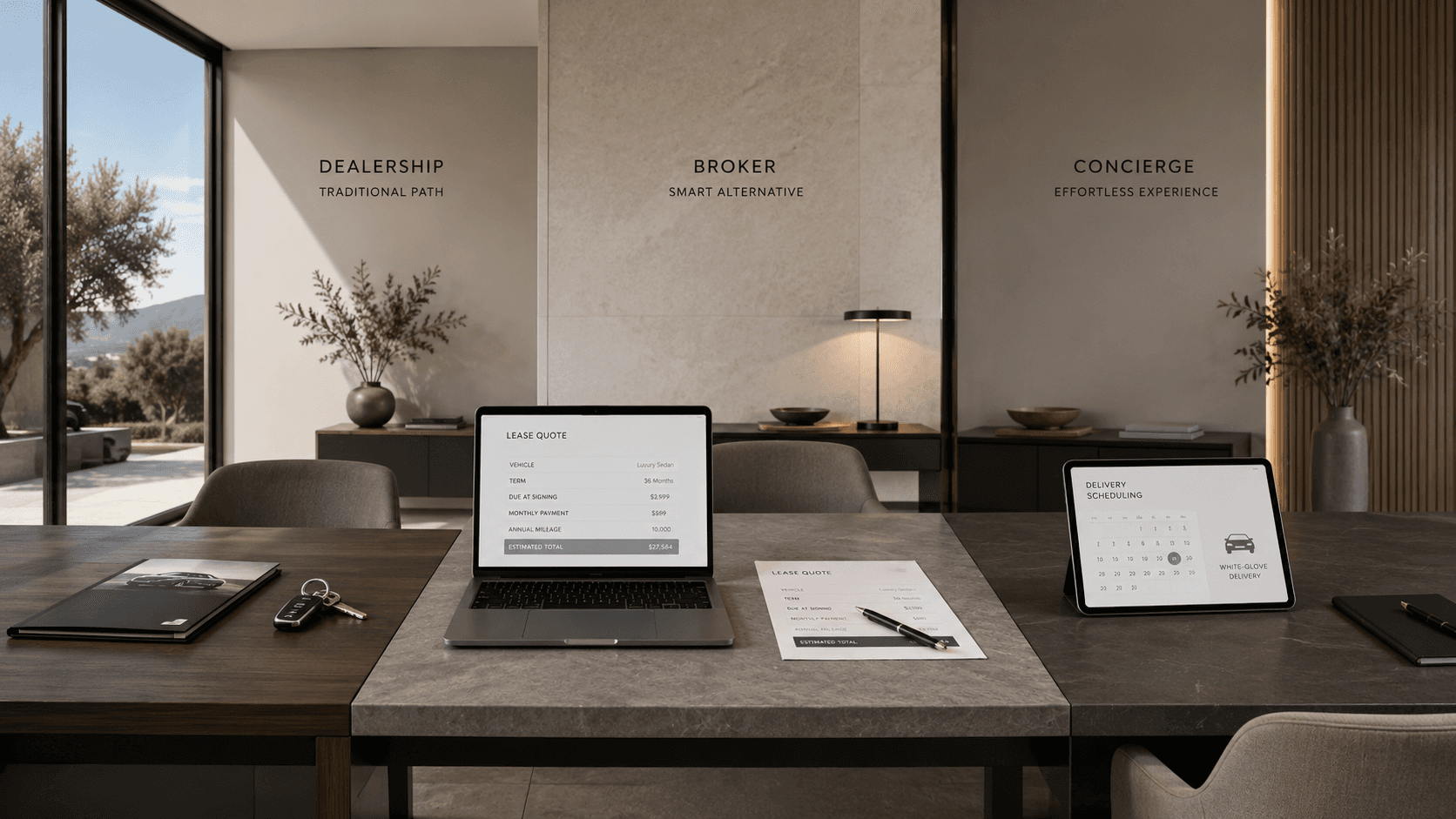
A role-by-role comparison of the three California paths into a lease, organized around license posture, fee structure, and the specific levers each role controls during the deal.
Three different licensed roles in California
A franchised dealer holds a California dealer license under the Vehicle Code's occupational licensing chapter and operates under a manufacturer franchise to sell new vehicles of a specific brand. A car broker, in California's statutory sense, is an autobroker - a licensed dealer with an autobroker endorsement under Vehicle Code section 11733, acting as the agent of the retail buyer. A concierge service like AAA Auto Buying or the Costco Auto Program is a third-party platform connecting members with participating dealers under a pre-arranged price program; the program is not a California autobroker and does not generate a section-11735 agreement. Three roles, three license postures, three signature paths.
How fees and revenue flow across the three roles
The dealer earns the spread between invoice and the lease cap cost, plus any F&I products the buyer accepts at signing. The broker earns the autobroker fee disclosed in the section-11735 agreement, paid by the buyer. The captive lender earns the spread between cost of capital and the money factor under Regulation M's lease disclosures. The concierge program is typically funded indirectly: a membership fee (AAA, Costco, Sam's Club) or subscription (Consumer Reports) covers the platform, and participating dealers pay program fees in return for member traffic. The three structures look similar from the buyer's chair, but the cash flows and incentives diverge in ways that matter when a deal goes off-script.
What each role actually controls during a deal
The dealer controls inventory placement, F&I product offerings, the vehicle's first registration through DMV, and physical delivery. The broker controls sourcing across multiple dealers, the autobroker agreement disclosures, quote presentation, and the workflow from inquiry to signing day. The captive lender controls the residual percentage, money factor, program incentive structure, credit decision, and post-sale lease servicing. The concierge program controls the platform pricing rule and the participating-dealer roster but does not transact directly. Each role has a clear scope; expecting a role to fix something outside its scope is the source of most broken expectations.
When the broker, dealer, or concierge is the right pick
A broker fits a shopper who values a written buyer-agent agreement, broader sourcing across the California dealer network, and a structured quote workflow. A dealer fits a confident negotiator targeting a high-volume configuration in local inventory who is comfortable working price, trade, and F&I directly. A concierge fits an established member of AAA, Costco, Sam's Club, or Consumer Reports whose target brand is in the program's local network and who values the program's pre-arranged price as a baseline. The fit depends on shopper profile, target vehicle, and time available - not on which path 'sounds best' in marketing language.
The five-question test for picking a path
Five questions usually settle the choice. First: is the target configuration sitting on a local lot today? If yes, the dealer-direct path is fine. Second: does the shopper have a current AAA, Costco, Sam's Club, or Consumer Reports membership covering the target brand? If yes, the concierge program is a low-friction option. Third: does the shopper want a written buyer-agent agreement under section 11735 before any credit pull? If yes, the broker channel is the fit. Fourth: does the shopper have weekend time to negotiate in person? If no, the broker channel handles the cycle. Fifth: does the shopper have a credit-union pre-approval ready? If yes, the financing leverage is largely independent of which channel handles the quote.
Where 021 sits in the comparison
021 Auto Leasing operates as a California-based broker channel and routes shoppers to lender and dealer partners. 021 is not a franchised dealer of any specific brand and is not a member-program concierge service; the legal posture is the autobroker channel. 021 is not the lender of record on any quote, and live monthly lease payments do not appear on this blog post; they appear only on the active deal feed when a current dated program is alive. Approval, residual, money factor, and program structure depend on the captive lender or bank reviewing the application.
How a shopper can audit the role on a specific contact
When a shopper is on the phone or in an email exchange and is unsure which role the contact is operating in, three sentences usually settle the question. First: 'Are you a California-licensed dealer with an autobroker endorsement, and can I verify it through DMV?' If yes, the contact is operating as an autobroker. Second: 'Are you a member-program platform connecting me with a participating dealer?' If yes, the contact is the buying-service path. Third: 'Are you a franchised dealer of this brand directly?' If yes, the contact is the dealer-direct path. None of the three is incompatible; some businesses wear two hats. But the audit clarifies which legal posture is operating on the specific transaction.
How the three roles emerged in California car retail
The three roles in this comparison did not appear at the same time. Franchised dealers are the oldest layer; California vehicle retail has run through manufacturer-franchised stores for most of its modern history. Autobrokers as a named, separately-licensed category emerged in California to formalize what some dealer staff had been doing informally as buyer-agents; Vehicle Code sections 11733 and 11735 set the framework. Concierge programs emerged from the membership organization side - AAA, Costco, Sam's Club - looking for ways to extend member benefits into a high-value purchase. The three roles solve different problems and remain useful for different shopper profiles; treating them as substitutes misses the structural differences.
When a deal goes sideways: who handles what
Across the three paths, support escalation runs through different parties. On a broker-mediated deal, the broker handles agreement-side disputes, the selling dealer of record handles vehicle-side disputes (delivery condition, F&I products), and the lender of record handles lease-side disputes (billing, end-of-lease). On a dealer-direct deal, the dealer handles vehicle-side and most agreement-side disputes; the lender handles lease-side. On a concierge program, the platform handles program-rule disputes and the participating dealer handles vehicle-side; the lender of record again handles lease-side. Knowing which party owns which category before signing day is what turns a problem into a fixable problem rather than a confused ping-pong between three different phone numbers.
What stays the buyer's responsibility across all three paths
Five responsibilities stay with the buyer regardless of channel. Reading the lease contract before signing is one; the lender's pre-contract disclosures under Regulation M arrive in writing on every path. Getting a credit-union pre-approval as a comparison baseline is two; the CFPB recommends it for any auto financing decision. Verifying the vehicle's identification and condition at delivery is three; the walk-around establishes the baseline for any future excess-wear charge. Confirming the contract names the actual garaging address for California sales tax purposes is four. Keeping the autobroker agreement, the dealer worksheet, and the lender contract in one place is five; future questions are much easier to resolve with the documents on hand.
When the right answer is none of the three
A small fraction of California shoppers need none of broker, dealer-direct, or concierge. A buyer with a strong credit-union pre-approval, a known target configuration, and a deep relationship with a specific dealer's general manager may transact directly through that relationship. A long-tail enthusiast model with no captive program and no concierge coverage may go through a specialist broker outside this category map. A fleet or business lease may run through a commercial-lease channel rather than any of the consumer paths. Naming the edge cases honestly avoids forcing every shopper into one of the three boxes; the role comparison is useful for most shoppers, not all.
Frequently Asked Questions
Can one company be both a dealer and a broker in California?
Yes. A California-licensed dealer can hold an autobroker endorsement and operate both sides. The buyer still receives the section-11735 agreement on the broker-side transaction; the dual role does not waive the disclosure.
Is the Costco Auto Program the same as a broker?
No. Costco's program is a member benefit connecting members with participating dealers under pre-arranged member pricing. The program is not a California autobroker under Vehicle Code section 11733 and does not generate the section-11735 agreement.
Which path is cheapest?
There is no universal answer. The captive lender's program inputs apply to any qualifying buyer regardless of channel. Cost differences usually come from cycle time, F&I friction, trade-in handling, and any platform fee or autobroker fee, not from a hidden rate.
Should I avoid the dealer's F&I lane?
F&I products can be useful or unnecessary depending on the buyer. The cleanest approach is deciding which add-ons to consider before signing day, then accepting or declining each one at the dealership. FTC truth-in-advertising rules apply to advertising claims about F&I products.
Do these three roles ever overlap on a single deal?
Sometimes. A franchised dealer with an autobroker endorsement can act in either capacity; a concierge program can route a member to a participating dealer whose broker desk also runs separately. The disclosures and the section-11735 agreement still apply to whichever role is operating on the specific transaction.
Related 021 resources: lease broker, car concierge, definition, California broker shopper playbook, compare broker and dealer paths.