General
-
021 Auto Leasing
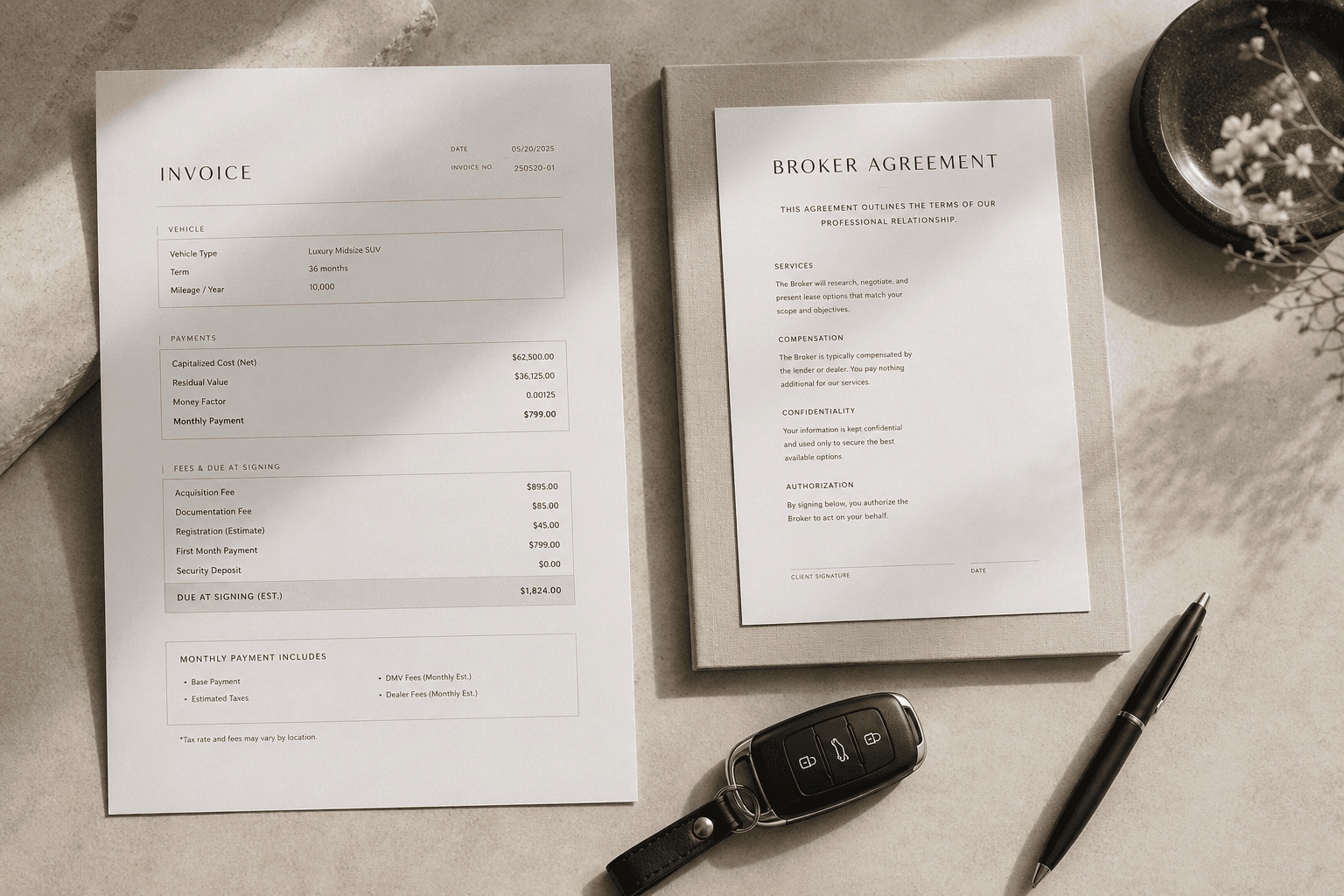
A transparent explainer on California car broker fees, covering the section-11735 disclosure requirement, common fee structures, and the questions a shopper should ask before signing the autobroker agreement.
What California requires on broker-fee disclosure
California Vehicle Code section 11735 requires the autobroker to provide a written agreement before the buyer becomes obligated, naming the make, model, accessories, vehicle price ceiling, autobroker fee, and buyer-agent role. The disclosure has to appear in writing - not in a verbal commitment, not in a follow-up email after the credit application. The DMV's Occupational Licensing branch administers the autobroker endorsement, so a buyer who has the dealer license number and the section-11735 agreement template has the data set the law actually requires. A broker who treats the fee disclosure as optional is signaling something the buyer should weigh seriously.
Common broker fee structures
Three fee patterns appear most often. A flat fee is a fixed dollar amount per deal, set in the autobroker agreement and paid by the buyer; this structure is predictable and is the easiest to compare across brokers. A deal-tied fee scales with the deal size or vehicle price and is also disclosed in the agreement; this structure can produce a higher fee on a more expensive vehicle. A hybrid structure combines a base flat fee with a smaller deal-tied component. None of the structures is automatically better; they are different ways of pricing the same service. The honest comparison is the total fee on the specific deal compared against the alternative paths the buyer would otherwise use.
Where the broker fee sits relative to other revenue
Three revenue pots run in parallel on a broker-mediated lease. The captive lender or bank earns the spread between cost of capital and the money factor disclosed under Regulation M. The selling dealer of record earns the spread between invoice and the lease cap cost, plus any F&I products the buyer accepts at signing. The broker earns the autobroker fee disclosed in the section-11735 agreement. None of those pots is hidden; each appears on a different document the buyer keeps. A shopper who reads all three knows where the money is going. A shopper who reads only the lease contract sees the lender's portion but not the broker's; reading all three together is the discipline.
Six fee transparency questions to ask before signing
Six questions surface the full fee picture. What is the autobroker fee on this specific deal, in writing? Is the fee flat, deal-tied, or hybrid? Is there a documentation or processing fee separate from the autobroker fee? Is the fee refundable if the lender does not approve on the quoted terms? Is the fee disclosed in the section-11735 agreement before any credit pull? Are there any additional fees the broker collects beyond the autobroker fee? A clean broker answers all six in writing, in the agreement or in a follow-up email referenced in the agreement; partial answers are partial commitments.
What 'no fee' or 'zero fee' broker claims usually mean
A 'no fee' broker claim usually means one of three things. The broker is funded by a dealer-side referral arrangement rather than a buyer-paid fee. The broker is operating outside the autobroker framework and is not actually a California autobroker under section 11733. The fee is real but is bundled into another line item the shopper has not noticed. None of those is automatically problematic, but each is worth understanding before signing. A genuine no-fee structure should still produce a section-11735 agreement if the party is operating as an autobroker; if the agreement is missing, the buyer should ask whether the party is actually licensed as one. 021 Auto Leasing operates as a California-based broker channel and is not the lender of record on any quote; live monthly payments appear only on the active deal feed.
Why fee transparency matters more than fee size
Buyers commonly worry about the size of the broker fee. The more important question is whether the fee is fully disclosed before any commitment. A modest fee paired with a clear section-11735 agreement and a clean quote sheet is a stronger position than a slightly smaller fee buried in fine print. California Vehicle Code section 11735 was written precisely to surface fee structures before the buyer becomes obligated; the rule's intent is transparency, not low fees. A shopper who asks the fee transparency questions first and the fee size questions second is reading the rules the way they were written.
Reading a sample autobroker fee disclosure
A typical California autobroker agreement names the fee in a dedicated line item under section 11735, with the structure (flat or deal-tied), the amount, the payment timing (at signing or at delivery), and the refundability terms. The disclosure usually appears alongside the make, model, accessories, and the vehicle price ceiling the buyer has agreed to. A shopper reading the disclosure for the first time should look for four things: the fee amount in dollars, the structure (so the fee on a more expensive vehicle is predictable), the refundability if the lender does not approve on the quoted terms, and any additional fees beyond the autobroker fee. If any of those four is missing, the buyer asks for it in writing before signing.
What the dealer's F&I lane has to do with the broker fee
The F&I lane at the selling dealership is a separate revenue source from the autobroker fee, but it can quietly raise the out-the-door cost on a broker-mediated deal if the buyer is not prepared. F&I products like extended warranty, gap insurance, paint protection, and pre-paid maintenance are sold at signing; FTC truth-in-advertising rules apply to advertising claims about them. A clean approach is deciding which products to consider before signing day, then accepting or declining each one at the dealer. The broker's quote covers the lease structure, not the F&I products; the buyer signs the lease as quoted and handles the F&I conversation as a separate decision.
Frequently Asked Questions
Is the autobroker fee tax-deductible?
Tax treatment depends on the buyer's specific situation. The fee itself is disclosed under section 11735 as part of the agreement; tax advice is outside the broker channel's scope and should come from a tax professional.
Can the broker fee be financed into the lease?
Some buyers fold the fee into the deal structure; others pay it separately. The fee disclosure has to appear in the section-11735 agreement before the buyer is obligated; how it is paid is part of the agreement.
Are there typical broker fee ranges in California?
Fee levels vary by broker, deal complexity, and target vehicle; specific ranges are best obtained directly from each broker in writing. Avoid relying on third-party 'typical fee' claims without dated source data.
What if the lender does not approve on the quoted terms - is the fee refundable?
The agreement should state the refund policy explicitly. Some brokers refund the fee on non-approval; others do not. Ask in writing before signing the section-11735 agreement.
Is the autobroker fee included in the monthly payment?
It depends on the structure agreed in the section-11735 agreement. Some buyers pay the fee separately at signing; others fold it into the deal structure where the captive lender allows. The structure has to appear in the agreement.
Related 021 resources: lease broker, fees, lease pricing, California broker shopper playbook, request transparent quote review.