General
-
021 Auto
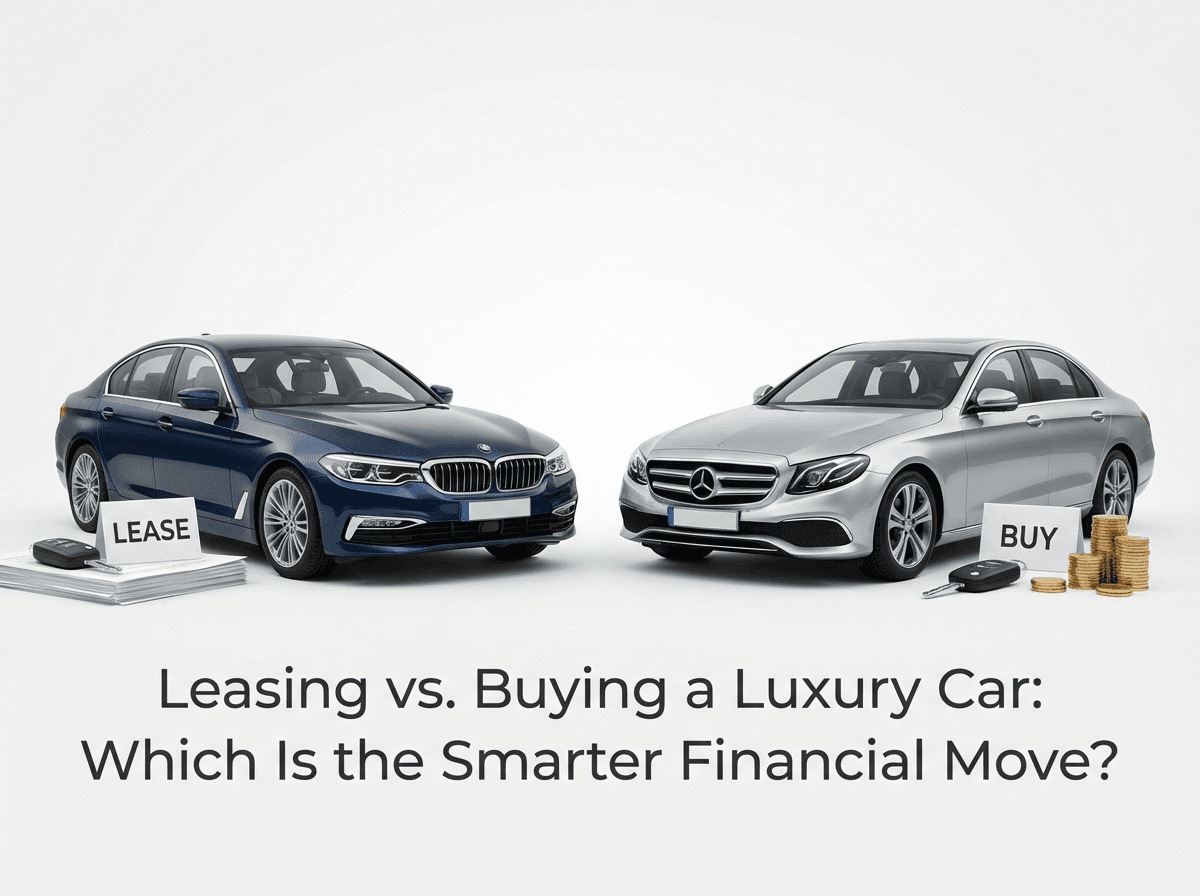
You've decided you want a luxury car. The real question isn't which one — it's how to pay for it. Should you lease or buy? The answer depends on how you drive, how long you keep your cars, and whether you're willing to absorb the brutal depreciation that comes with owning a premium vehicle. If you've been searching for a car lease broker near me to help make sense of the numbers, you're already thinking about this the right way. This guide breaks down the real costs of owning versus leasing vehicles like the Mercedes C300, G Wagon, and Audi A5 — with specific numbers that might surprise you.
The True Cost of Buying a Luxury Car
Most people think about the sticker price when they buy a car. But the sticker is just the beginning. The true cost of owning a luxury vehicle includes depreciation, financing, insurance, maintenance, and repairs — and over five years, that total can be staggering.
Depreciation: The Hidden Expense Nobody Talks About
Depreciation is the single biggest cost of car ownership, and it hits luxury vehicles harder than almost any other category. According to Kelley Blue Book, a 2025 Mercedes-Benz C300 with a starting MSRP around $49,600 will lose approximately $30,000–$32,000 in value over the first five years. That's roughly a 50–53% decline — meaning your $50,000 sedan is worth about $19,000–$20,000 by year five. You're effectively paying $500+ per month just in lost value before you factor in a single other expense.
The numbers get even more dramatic as MSRPs climb. A 2025 Mercedes-AMG G63, which carries an MSRP around $187,000, is expected to depreciate about $82,000 over five years according to KBB — though the G Wagon's iconic status and high demand mean it still retains roughly 56% of its value, which is exceptional for a luxury SUV. Most competitors lose far more.
Financing, Insurance, and Maintenance Over Five Years
Beyond depreciation, KBB estimates the five-year cost to own a 2025 C300 4MATIC at roughly $81,000 total, and a G63 at approximately $176,000. Those figures include financing costs at typical rates, insurance premiums (which run significantly higher on luxury vehicles), fuel, and scheduled maintenance. Mercedes-Benz maintenance isn't cheap after the initial prepaid service period expires — expect $1,500–$3,000 annually for routine service, and potentially more if something major goes wrong outside warranty.
Real Numbers: C300 and G Wagon Total Cost of Ownership
Here's what five years of ownership actually looks like. For a C300 4MATIC purchased at MSRP, your total outlay — including the purchase price, financing interest, insurance, fuel, maintenance, and depreciation — lands near $81,000. Divide that by 60 months, and you're spending roughly $1,350 per month to own this car, even after accounting for the ~$19,000 residual value you'd get back at resale.
For the G63, that five-year total hits approximately $176,000, or about $2,930 per month all-in. The G Wagon's stronger residual value helps offset some of that cost, but you're still writing very large checks every month for the privilege of ownership. These are the real numbers that make a C300 lease or a G Wagon lease worth serious consideration.
Why Leasing Makes Sense for Luxury Vehicles
Once you see the true cost of ownership, leasing starts to look less like "renting" and more like a calculated financial strategy — especially in the luxury segment. And when you work with a car lease broker near me, the numbers get even better.
Depreciation Protection: You Only Pay for What You Use
The core advantage of leasing is straightforward: you pay for the vehicle's depreciation during your lease term and nothing more. On a 36-month C300 lease, you're covering roughly three years of depreciation (typically 35–40% of the vehicle's value) plus a money factor (the lease equivalent of an interest rate) and fees. The remaining value — the residual — is the manufacturer's problem, not yours.
This is where leasing really shines for luxury cars. Because premium vehicles depreciate more in dollar terms than mainstream cars, the gap between your lease payment and a comparable loan payment is wider. You're essentially shielding yourself from the most expensive years of a luxury car's life.
Lower Monthly Payments and Cash Flow Benefits
The monthly payment difference between leasing and buying is significant. A 2026 Mercedes C300 4MATIC can currently be leased for around $519–$569 per month on a 36-month term (with money due at signing), according to current manufacturer-backed offers. A comparable finance payment on the same car over 60 months at typical rates would run closer to $900–$1,000 per month.
An Audi A5 lease tells a similar story. With an MSRP around $54,000 for the 2025 A5 Quattro Premium, advertised lease payments fall in the $450–$600 range on a 36-to-39-month term, while a financed purchase would cost considerably more per month. That freed-up cash can go toward investments, savings, or simply a higher quality of life.
Even at the high end, a G Wagon lease keeps monthly costs more predictable than financing. While G63 lease payments are substantial — typically in the $2,500–$4,000+ range depending on configuration — they're still meaningfully lower than the all-in monthly cost of ownership we calculated earlier. Considering a G Wagon lease through a broker can bring that range down further.
Always Driving the Latest Model
Leasing also means you're always in the newest version of your vehicle. In the luxury segment, where technology, safety systems, and infotainment evolve rapidly, this matters more than in mainstream cars. The 2026 C-Class, for example, comes with a third-generation MBUX infotainment system, a 48-volt mild hybrid, and the latest driver assistance features. If you'd purchased a C300 three years ago, you'd be driving older tech and facing the decision of whether to sell at a loss or keep driving an aging vehicle.
Want to see what a C300 lease would cost through our concierge service? Get a free quote →
When Buying Is the Better Choice
Leasing makes strong financial sense for most luxury car shoppers, but it's not the right call for everyone. Here are the situations where purchasing wins.
High-Mileage Drivers (15,000+ Miles Per Year)
Standard lease agreements typically cap you at 10,000–12,000 miles per year, with excess mileage penalties of $0.25–$0.30 per mile on most luxury brands. If you commute 25,000 miles annually, those overage charges would add $3,250–$5,400 per year to your costs on a 10,000-mile lease — which obliterates any savings. If you consistently drive more than 15,000 miles per year, purchasing and holding the vehicle long-term usually makes more financial sense.
Some leases do offer 15,000-mile-per-year options, but the higher mileage allowance raises your monthly payment and eats into the cost advantage of leasing. A car lease broker near me can help you model the exact break-even point for your driving habits, but the general rule holds: heavy drivers should buy.
Cars That Hold Value Exceptionally Well
Certain vehicles depreciate so slowly that the cost of ownership over five to seven years becomes genuinely competitive with leasing. The Mercedes G Wagon is the prime example — retaining roughly 56–57% of its value after five years, according to KBB, which ranks it among the top vehicles for resale value nationally. The Toyota Land Cruiser, Porsche 911, and Jeep Wrangler fall into this category too.
If you're set on a vehicle with historically strong resale values and you plan to keep it for many years, buying can make sense. But be honest with yourself: most luxury car buyers trade up within three to four years regardless of their intentions, which is exactly the cycle that leasing is built for.
Building Long-Term Equity With a 7+ Year Plan
If you genuinely plan to keep a vehicle for seven or more years, buying wins on pure math. Once the loan is paid off (typically at 60–72 months), you have years of payment-free driving ahead. A C300 that costs $81,000 over five years might only cost another $15,000–$20,000 in maintenance, insurance, and fuel over the next two to three years — significantly less than leasing a new vehicle.
The catch? Luxury cars outside of warranty can get expensive. Mercedes-Benz's factory bumper-to-bumper warranty covers four years or 50,000 miles. After that, you're on your own for repairs, and complex systems like AIRMATIC suspension, MBUX electronics, and turbocharged engines aren't cheap to fix. A car lease broker near me can run the numbers on both scenarios — long-term ownership versus a lease cycle — so you make the decision with real data, not guesswork.
The Broker Advantage for Both Leasing and Buying
Whether you decide to lease or buy, how you acquire the vehicle matters just as much as which payment structure you choose. This is where working with new car brokers near me gives you a significant edge.
How Auto Brokers Secure Better Numbers on Either Option
When you walk into a dealership, you're negotiating against people who do this every day. An auto broker flips that dynamic. At 021 Auto Leasing, we negotiate with multiple dealers simultaneously as your Los Angeles car broker, using volume relationships and market knowledge to secure pricing that's typically thousands below what a walk-in customer would pay.
On a lease, a lower negotiated price (the "capitalized cost") directly reduces your monthly payment. On a purchase, it means less to finance and less interest paid over the life of the loan. Either way, the savings are real and measurable. On a vehicle like the C300 or Audi A5, we routinely secure 6–10% off MSRP, which translates to $3,000–$5,000 in savings — or roughly $80–$140 less per month on a 36-month lease. For higher-priced models like the G Wagon, the dollar savings can be even larger.
Auto brokers near me also handle the entire process — sourcing the exact vehicle you want, negotiating the deal, and managing the paperwork. You never set foot in a dealership unless you want to pick up the keys.
Tax Implications for Business Owners
If you use your luxury vehicle for business, the lease-vs-buy decision has additional tax dimensions worth understanding. Business owners can typically deduct lease payments as a business expense, which simplifies accounting and spreads the tax benefit over the lease term.
For purchasers, Section 179 of the tax code allows businesses to deduct a portion of a qualifying vehicle's cost in the year it's placed in service. For SUVs weighing over 6,000 pounds GVWR — like the Mercedes G Wagon — the Section 179 deduction is capped at $31,300 for the 2025 tax year, with additional bonus depreciation potentially available on the remaining cost. Lighter vehicles like the C300 and Audi A5 fall under stricter "luxury auto" depreciation limits, capping the first-year deduction at around $20,400 for 2025.
These are significant numbers that can change the math entirely. A car lease broker near me who understands both the financial and tax angles can help you model the right scenario for your business. (Always consult your tax advisor for advice specific to your situation.)
Frequently Asked Questions
Is it cheaper to lease or buy a luxury car like the Mercedes C300? On a monthly basis, leasing is almost always cheaper. A C300 lease typically runs $500–$570 per month, while financing the same car costs $900–$1,000 per month. However, buying becomes cheaper in the long run if you keep the vehicle for seven or more years and avoid costly repairs.
How much does a G Wagon depreciate in the first three years? The Mercedes G Wagon depreciates less than most luxury SUVs, losing roughly 35–40% of its value in the first three years. That's still a substantial dollar amount given the G63's $187,000+ MSRP, but it's far better than competitors like the BMW X7 or Range Rover, which can lose 50–60% in the same period.
Can a car lease broker near me really save money on a luxury car lease? Yes. Brokers negotiate with multiple dealers to secure below-MSRP pricing, which directly lowers your capitalized cost and monthly payment. On a vehicle like the C300 or Audi A5, typical savings range from $3,000–$5,000 off sticker, translating to $80–$140 less per month on a 36-month lease.
What are the tax benefits of leasing a luxury car for business use? Business owners can generally deduct lease payments as a business expense. For purchased vehicles, Section 179 allows a first-year deduction of up to $31,300 for heavy SUVs (over 6,000 lbs GVWR) and up to $20,400 for lighter passenger vehicles in 2025. Consult a tax professional for your specific situation.
Should I lease or buy an Audi A5? For most drivers who keep cars three to four years, an Audi A5 lease makes strong financial sense. The A5 depreciates significantly in the first few years, so leasing protects you from that loss. If you drive fewer than 12,000 miles per year and like having the latest technology, leasing is likely the smarter move.
Not Sure Whether to Lease or Buy? Let Us Help.
The lease-vs-buy decision depends on your driving habits, financial goals, and how long you plan to keep the vehicle — and a car lease broker near me can walk you through the numbers for your specific situation. At 021 Auto Leasing, we help clients across Los Angeles lease and purchase luxury vehicles like the Mercedes C300, G Wagon, and Audi A5 at prices well below what you'd negotiate on your own. Every consultation is free, and there's zero obligation. Skip the dealership — contact 021 Auto Leasing and let us show you the smartest way to get into your next luxury car.
Related 021 resources: best luxury cars to lease, Mercedes C300 lease guide, request a lease-vs-buy consultation.